The short version
What actually happens during the visit
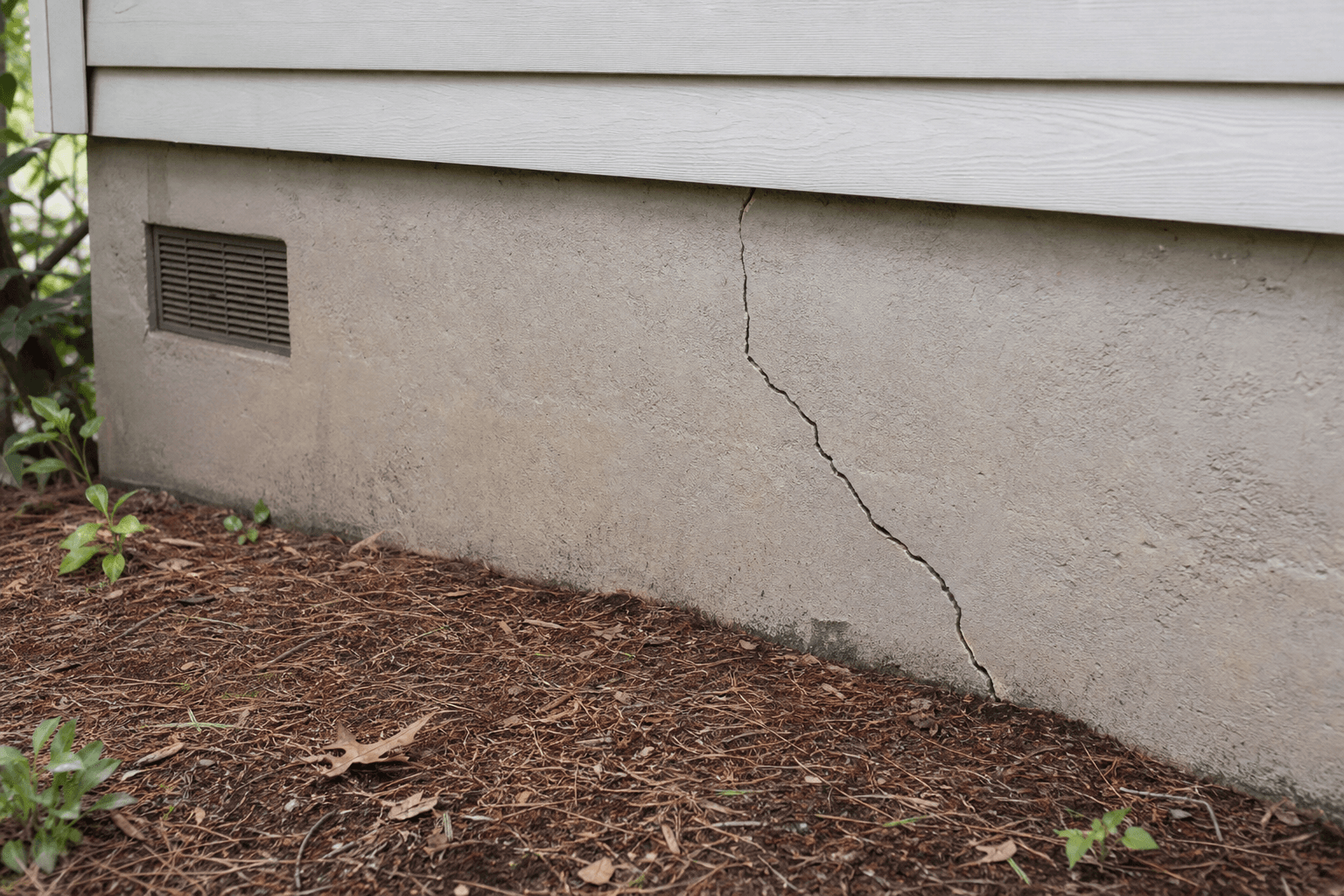
A foundation inspection is a focused walk-through of the outside, the inside, and the crawl space or basement, usually taking one to two hours. The inspector documents cracks, movement, drainage and support conditions, often takes floor elevation readings, and issues a written report with findings and recommended repairs.
The order rarely varies, because each stage informs the next. It starts outside: a full lap of the house looking at the exposed foundation wall, brick or block above it, the slope of the ground away from the house, where downspouts discharge, and whether anything is holding water against the foundation. Then inside, where the evidence is indirect — cracks at door and window corners, drywall separations, floors that feel off, doors that catch. Then underneath, in the crawl space or basement, at piers, posts, beams, joists, wall condition and moisture. Many inspectors finish with elevation readings taken room to room.
A good inspector will ask you what you have noticed before they start, and will want to know when you first saw it. That is not small talk — whether something is new or has been there for a decade changes what the same crack means.
Who you're calling
Contractor, engineer, or home inspector?
“Foundation inspection” describes three different visits performed by three different people with three different incentives. Knowing which one you have booked is the single most useful thing to sort out before the appointment.
| Who | What it costs | What you're actually getting |
|---|---|---|
| Foundation repair contractor | Usually free. Inspects to produce a repair quote, often with elevation readings and photos. | Fast, detailed, and specific about methods — but they earn money only if repairs follow, so get a second opinion on expensive scopes. |
| Licensed structural engineer | Typically several hundred to a few thousand dollars, depending on depth and home size. | Sells no repairs, so the opinion is independent. Best when the work is costly, recommendations conflict, or a lender, insurer, or buyer wants a report. |
| General home inspector | Part of a whole-house inspection fee during a purchase. | Broad rather than deep. Flags concerns and refers on; does not usually take elevation readings or specify repairs. |
Most homeowners start with the free contractor inspection, and that is a reasonable place to start. Our guide on whether to call a structural engineer or a foundation contractor covers the decision in more depth.
Said plainly
What a “free inspection” actually is
Nearly every foundation repair company offers a free inspection, and the offer is genuine — you will not be billed. It is worth understanding what it is, though, because almost nobody publishing on this topic will tell you: it is a sales visit with a real inspection inside it. The company earns nothing unless repairs follow.
That is not an accusation. The technical work is often thorough, the technicians are frequently very experienced with local soils, and reputable companies do regularly tell homeowners that nothing needs doing. Free inspections are how a competitive industry generates leads, and the arrangement is normal.
What it does mean is that a free inspection is a well-informed opinion from an interested party, not an independent verdict. Three practical consequences:
Get more than one
Two or three inspections of the same house, described in the same words, is how you find out whether the scope is real. Our outreach kit sends the same questions to each.
Scale scrutiny to the price
A crack seal quoted at a few hundred dollars needs less checking than a pier scope quoted in the tens of thousands.
Pay for independence when it matters
On an expensive or disputed scope, an engineer's fee is small next to the repair and buys an opinion with nothing riding on it.
When you are ready to approach several companies with the same description and the same questions, the contractor outreach kit builds the message, and questions to ask a foundation repair company covers what to raise while they are there.
The measurement
What the elevation survey tells them
Many inspectors take floor elevation readings — with a manometer, a laser, or an altimeter-style instrument — recording the height of the floor at points through the house, often to about a tenth of an inch. Plotted on a floor plan, those readings show the shape of the floor rather than a single slope: where the high point is, where the low point is, and whether the fall is a gentle tilt across the whole house or a localized dip over one area.
That distinction matters more than the raw numbers. A house that tilts uniformly has often done so since it was built. A house with a distinct low corner is a different conversation. Ask for the readings themselves, not just the conclusion — they are your baseline, and re-taken in a year or two they are the only real evidence of whether anything is still moving. You can take a rough version yourself first with the floor slope calculator.
Afterwards
How to read the report you're handed
Reports vary from a one-page quote to a twenty-page engineering document. Whatever the length, the same seven things are worth locating — and the last one is where most unpleasant surprises are hiding.
| What to look for | What it is | Why it matters |
|---|---|---|
| Observations | What the inspector actually saw and measured — crack widths, locations, elevation differences, moisture readings. | This is the durable part of the report. Vague adjectives without numbers are hard to compare against a second opinion later. |
| Elevation readings or floor plan | Height differences measured room to room, often to a tenth of an inch, sometimes drawn on a plan. | Your baseline. Keep it — re-measured in a year or two, it is the only way to show whether anything is still moving. |
| Cause or mechanism | What the inspector believes is driving the movement — soil moisture, drainage, lost support, lateral pressure. | If a report recommends work without naming a cause, ask why. Fixing the symptom while the cause continues is how repairs get repeated. |
| Recommendation | Stabilize, correct or lift, improve drainage, or monitor. | Note which one it is. Stabilization stops further movement; correction attempts to recover position. They cost very differently. |
| Scope and count | Number of piers or anchors, linear feet, locations, and access requirements. | The part that makes quotes comparable. Two quotes for different pier counts are not two prices for the same job. |
| Exclusions and limitations | Areas not accessed — finished walls, blocked crawl space, insulation, stored belongings. | Read this first, not last. An inspection that could not reach half the crawl space has a correspondingly limited conclusion. |
| Engineering referral | A note that a licensed engineer should specify or review the repair. | Take it seriously when it appears, and expect it on larger structural scopes. |
The most common gap in a homeowner-facing report is a recommendation with no stated cause. If the document says a wall needs eight piers but never says what the inspector believes is happening beneath it, ask. A repair that treats the symptom while the cause continues is how the same work gets done twice.
Once you have two or more reports in hand, comparing foundation repair estimates walks through lining them up, and the quote analyzer checks whether a document is even clear enough to compare.
Preparation
Before the inspector arrives
An hour of preparation changes the quality of the visit, because it moves the inspector from hunting for problems to examining evidence you have already gathered.
Have ready
- A written list of what you have noticed, and roughly when it started.
- Dated photos, especially of anything that has changed.
- Any measurements you have taken, with the dates.
- Previous reports, repair paperwork, or transferable warranties.
- Clear access to the crawl space or basement, and to interior walls.
Worth asking on the day
- What do you think is causing this?
- Which parts couldn’t you access?
- Is this stabilization or correction, and what does each get me?
- What happens if I monitor it for a year instead?
- Does this scope need an engineer to specify or review it?
The foundation problem assessment organizes your symptoms into that written list, and the crack monitoring log turns “I think it’s got worse” into dated measurements.
Timing
When an inspection is worth booking
There is no need to inspect a house on a schedule. The triggers that usually justify one are a symptom that is new or changing: a crack that has widened, a door that started catching this year, a floor that has begun to feel uneven, or water appearing where it did not before. Several symptoms arriving together carry more weight than any one of them alone.
Transactions are the other common trigger — buying a house with visible cracks or past repairs, selling one where a buyer’s inspector has raised the foundation, or a lender or insurer asking for a report. See signs a house is settling for separating normal settling from movement worth acting on.
Cost
What an inspection costs
As planning ranges only: contractor inspections are usually offered free; independent structural engineer reports commonly run from several hundred dollars into the low thousands depending on the depth of the review and the size of the home; and some companies charge for inspections on homes actively listed or in escrow, sometimes crediting the fee against repair work. These are general ranges rather than quotes, and local pricing varies. For what the repairs themselves tend to run, see foundation repair cost.
FAQ
Foundation inspection FAQs
What does a foundation inspection consist of?
Most foundation inspections follow the same four-part route: a walk around the outside of the house looking at the foundation wall, grading, and drainage; a walk through the inside looking at cracks, floors, doors, and windows; a look under the house in the crawl space or basement at supports, moisture, and wall condition; and in many cases a set of floor elevation readings taken room to room. The visit usually ends with a written report of what was found and what the inspector recommends.
How long does a foundation inspection take?
One to two hours is typical for an average single-family home. A larger house, a difficult crawl space, or an inspection that includes a full elevation survey can run longer. If someone is in and out in fifteen minutes, they have looked at the one thing you pointed at rather than the house as a whole, and the report will reflect that.
Who can perform a foundation inspection?
Three different people can, and they are not interchangeable. A foundation repair contractor inspects in order to quote repairs, usually at no charge. A licensed structural engineer inspects independently and issues a report, typically for a fee in the several-hundred to low-thousands range. A general home inspector covers the foundation as one part of a whole-house inspection during a real estate transaction and will usually refer anything significant onward.
Are free foundation inspections really free?
You will usually not be billed, and the technical work is often genuinely useful. What you are receiving is a sales visit with an inspection inside it: the company performing it earns money only if repairs follow, so it has an interest in the outcome. That does not make the findings wrong, and reputable contractors do tell homeowners that nothing is needed. It does mean a free inspection is a starting point rather than an independent verdict, particularly where the recommended work is expensive.
What is the difference between a foundation inspection and a home inspection?
A home inspection is broad and shallow, covering roof, plumbing, electrical, HVAC, and structure across a couple of hours, usually as part of a purchase. A foundation inspection is narrow and deep, covering only the foundation and the structure it supports, and often includes elevation readings a home inspector would not take. A home inspector who flags foundation concerns is generally telling you to book the second kind.
Do I need a structural engineer or is a contractor enough?
A contractor's inspection is often enough for a straightforward, clearly-defined repair. An engineer is worth the fee when the recommended work is expensive, when two contractors disagree, when a lender, insurer, or buyer wants an independent report, or when you want a repair specification written before anyone quotes on it. An engineer who does not sell repairs has no financial interest in the answer.
How do I read a foundation inspection report?
Look for four things. What was actually observed, stated as measurements and locations rather than adjectives. What the inspector believes is causing it. What is recommended, and whether the recommendation is stabilization, correction, or monitoring. And what was excluded — the areas that could not be accessed, which is where the surprises usually live. If the report gives a repair scope without the observations that led to it, ask for the observations.
Should I get a foundation inspection before buying a house?
It is worth doing when the home inspection flags foundation concerns, when you can see cracks, sloping floors, or sticking doors yourself, or when the house has visible past repairs you want explained. In those situations an independent inspection before closing is far cheaper than discovering the scope afterwards. Ask the seller for documentation of any previous foundation work, including any transferable warranty.
Related guidance
Related pages
Local help
Arranging an inspection in eastern North Carolina
This site does not perform inspections or sell repairs. If you would like to be pointed toward an appropriate professional in the Rocky Mount area, you can request an inspection or share a foundation concern. Bring the list and the photos — the visit goes better when you do.