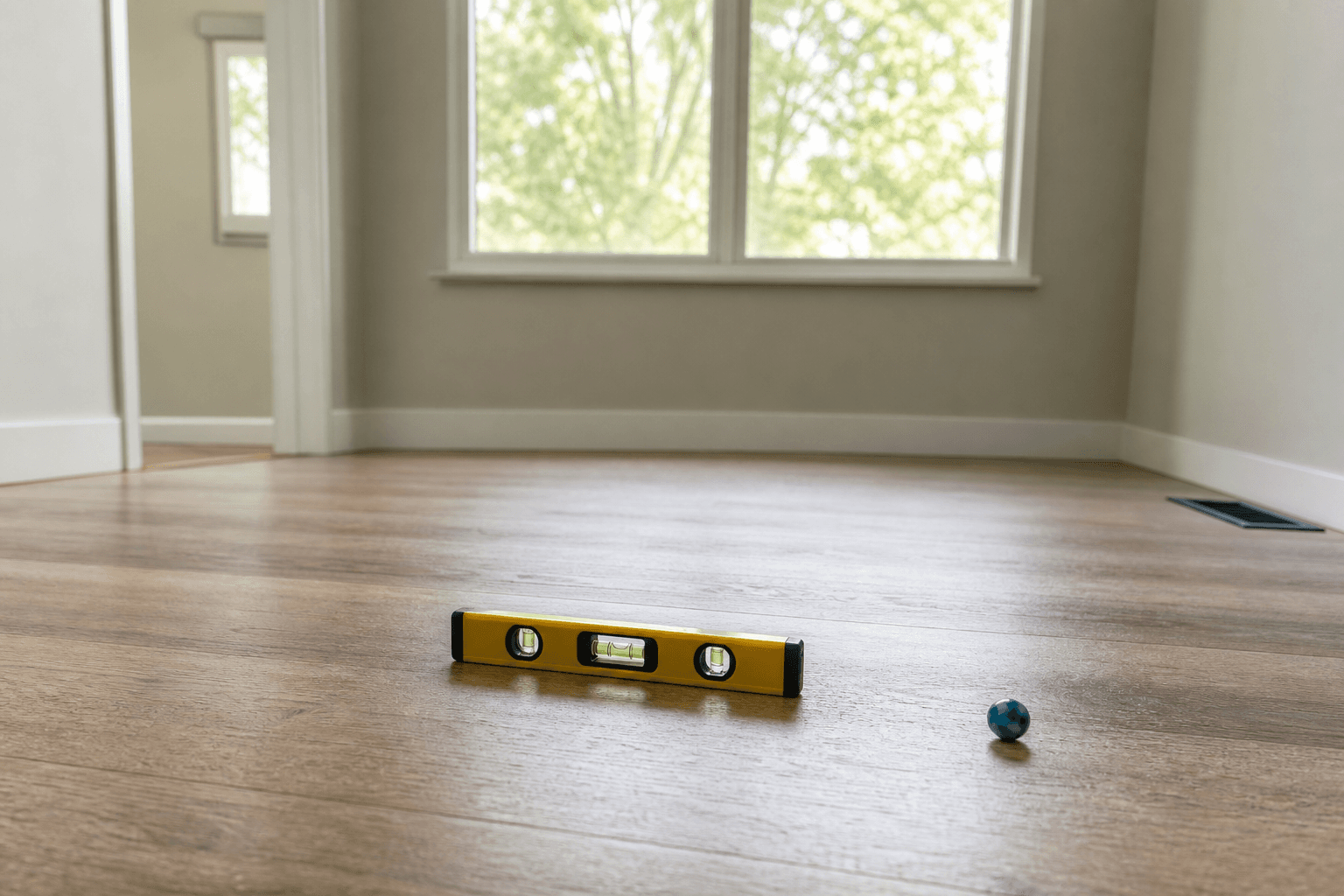
Start here
What house settling actually is
Settling happens when the soil under a home compacts under the weight of the structure. Most of it occurs in the first few years after a house is built and then slows down. A small amount of settling is normal and expected — it does not automatically mean the foundation is failing.
The distinction that matters is uniform versus differential settling. Uniform settling is when the whole house sinks evenly on similar soil; it rarely causes real damage. Differential settling is when different parts of the house drop at different rates — one corner, one side, or the area under a heavy feature like a chimney. That uneven movement is what cracks walls, tilts door frames, and slopes floors, and it is the pattern worth paying attention to.
Usually fine
Signs that are usually normal settling
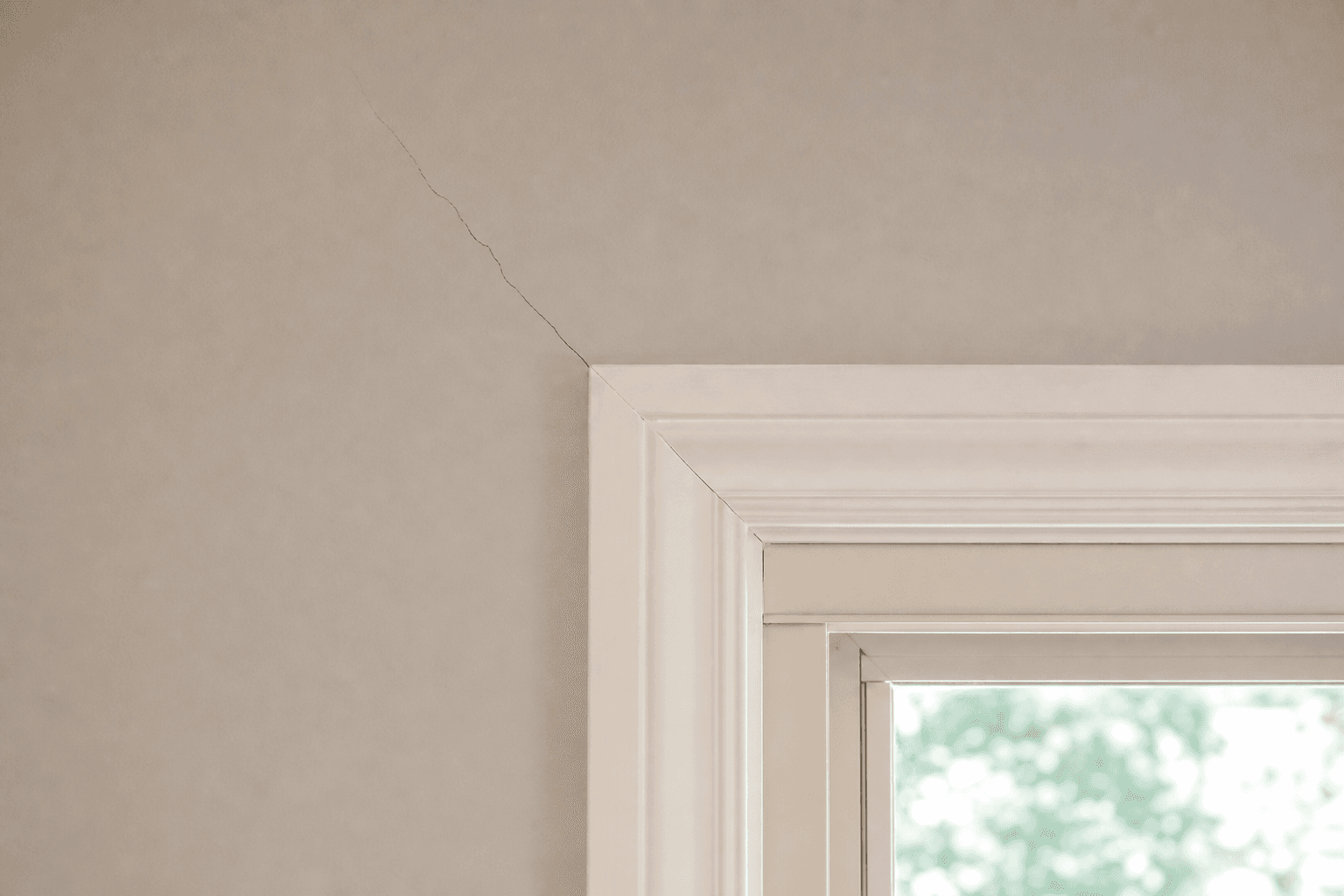
Thin hairline drywall cracks
Fine cracks near seams or corners that stay the same size over time.
Small vertical foundation cracks
Narrow up-and-down cracks are often from normal concrete shrinkage.
Minor nail pops or trim gaps
Small cosmetic movement that does not keep growing.
Stable over time
The single best sign of normal settling is that nothing is changing month to month.
Worth a closer look
Signs that point to a foundation problem
Cracks wider than 1/8 inch
Especially cracks that are widening rather than holding steady.
Horizontal or diagonal cracks
These point to pressure or uneven movement, not simple shrinkage.
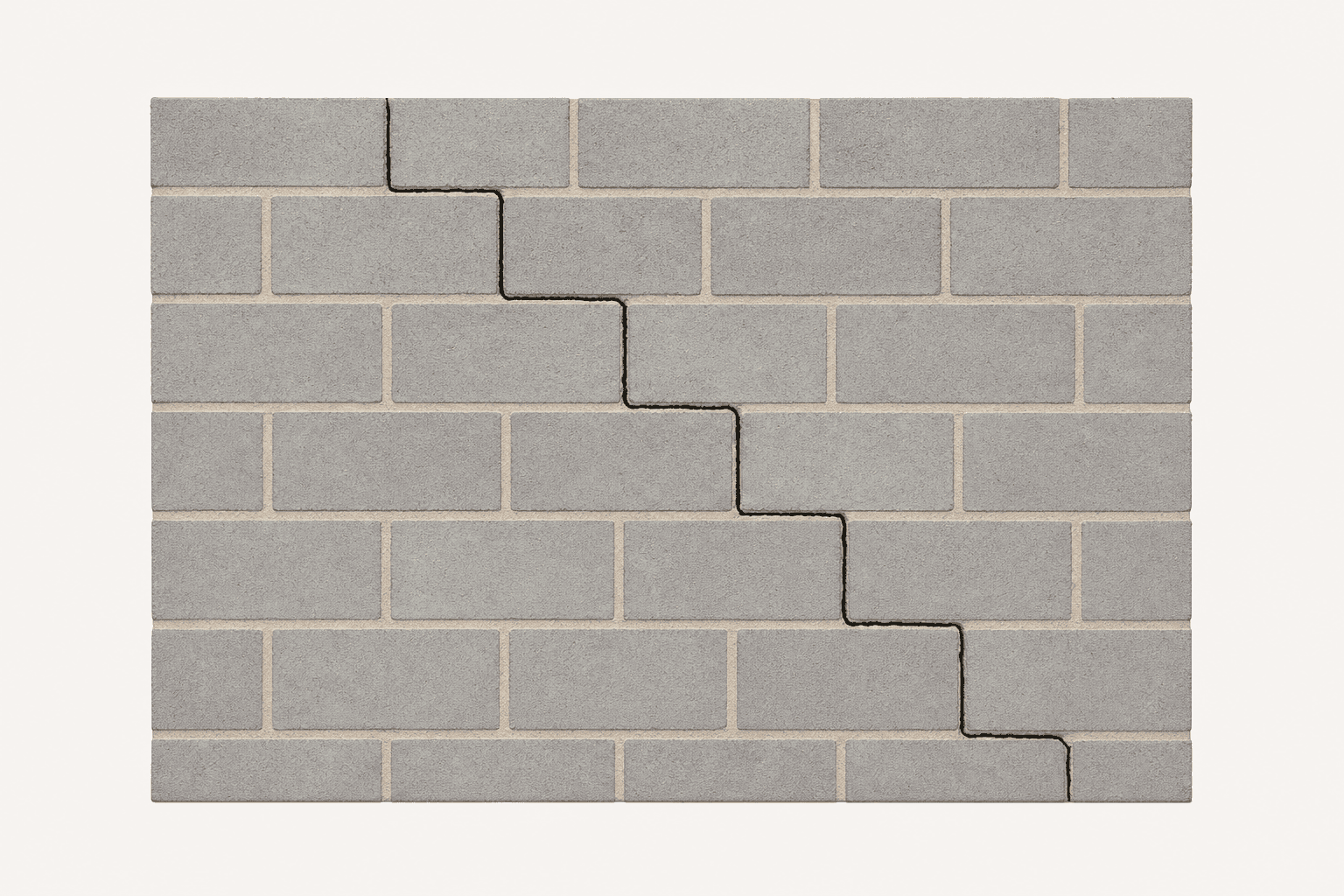
Stair-step cracks in brick or block
A classic sign of differential settlement along a wall or corner.
Doors and windows sticking more
Sticking that worsens over seasons rather than coming and going with humidity.
Gaps between walls and ceilings
Openings that appear or widen where surfaces used to meet.
Floors that slope or sag
Noticeable slope, often more than about 1/4 inch over 10 feet.
Tell the difference
Normal settling vs. worth an inspection
The same category of sign can be either harmless or concerning depending on its size, direction, and whether it is changing. This side-by-side is a general guide, not a diagnosis.
| Sign | Usually normal settling | Worth an inspection |
|---|---|---|
| Cracks | Thin, hairline, vertical, and stable | Wider than 1/8 inch, horizontal, diagonal, stair-step, or growing |
| Doors and windows | Seasonal sticking that comes and goes with humidity | Sudden or worsening sticking that does not reverse |
| Floors | Barely noticeable unevenness | Sloping more than about 1/4 inch over 10 feet, or visibly sagging |
| Gaps | Small, stable gaps at trim or molding | Widening gaps between walls, floors, and ceilings |
| Change over time | Stable for years | Actively changing, especially after drought or heavy rain |
How much is normal
How much settlement is considered acceptable
There is no single published limit that separates acceptable settlement from a problem, and anyone offering one is oversimplifying. What does exist is a set of commonly cited reference figures that give a sense of scale — useful for context, not for diagnosis.
| Reference | Commonly cited figure | How to read it |
|---|---|---|
| Settlement in the first year | Commonly cited as up to roughly 1/4 inch for a new home as the soil consolidates. | Expected. This is the bedding-in period, and it is why builders warn buyers about drywall cracks in year one. |
| Settlement in later years | Roughly 1/8 inch a year is often quoted as unremarkable for an established home. | Slow and uniform is the reassuring pattern. It is the rate, not the total, that tells you whether anything is happening. |
| Across a 20-foot span | Around 1/2 inch to 1 inch of fall is widely treated as within the range of ordinary construction. | Compare like with like: the same span measured the same way each time. Our floor slope calculator normalises this for you. |
| Uniform vs. differential | Uniform settlement moves the whole house together. Differential settlement moves one part relative to another. | This is the distinction that matters most. A house that has dropped evenly rarely shows damage; one that has dropped unevenly is what cracks walls and racks door frames. |
The fourth row is the one that actually decides things. Uniform settlement — the whole house moving down together — can be substantial without causing damage, because nothing is being pulled apart. Differential settlement moves one part of the house relative to another, and it is that difference across the structure, rather than the total drop, that opens cracks and jams doors. It is why a house can settle noticeably and look fine, while another settles less and shows damage throughout.
To turn this into a number for your own home, measure a floor rather than guess: the floor slope calculator converts a drop and a span into inches per 10 feet, a percentage grade, and an angular-distortion ratio, and reads the result against these tolerance ranges alongside the distress signs you can see. Measured twice, months apart, it also answers the more useful question of whether anything is still moving.
Why it happens
What causes problem settling
Differential settling usually traces back to how the soil under one part of the home is behaving differently from another. In eastern North Carolina, moisture swings and clay-influenced soils are frequent contributors.
| Likely cause | What is happening | What to check |
|---|---|---|
| Expansive clay soils | Clay swells when wet and shrinks when dry, moving the ground under the home | Common in clay-influenced eastern NC soils near the fall line |
| Poor drainage and heavy rain | Saturated or washed-out soil loses support | Watch gutters, downspouts, grading, and storm timing |
| Drought and tree roots | Soil shrinks and roots pull moisture from under the foundation | Large trees close to the home and long dry spells add risk |
| Weak original compaction | Soil that was not compacted well keeps settling under load | More likely in newer fill or added-on areas |
| Plumbing leaks under the slab | A hidden leak softens or erodes supporting soil | Unexplained damp spots or rising water bills can be clues |
Is it active?
How to tell whether settling is still moving
Document and monitor
Mark the ends of each crack with a pencil and the date, measure the width, and take dated photos. Re-check monthly and after big weather swings. A stable sign is far less concerning than one that is measurably moving.
When to call a professional
Reach out when cracks are widening, when several signs appear together, when floors are clearly sloping, or when you are buying or selling. A structural engineer can give a neutral opinion separate from any repair quote.
Related guidance
Related pages
FAQ
House settling FAQs
How much house settling is normal?
Some settling is normal for every home as the soil beneath it compacts under the weight of the structure. Normal settling usually shows up as thin, hairline drywall cracks or small vertical cracks that stay stable over time. It becomes a concern when cracks grow wider than about an eighth of an inch, turn horizontal or diagonal, or when several signs appear and keep changing.
How long does a house take to settle?
Most settling happens in the first few years after construction and then slows down. A house can shift again later when conditions change — for example after a drought, a very wet season, a plumbing leak, or nearby tree-root activity. What matters is less the age of the house and more whether the signs are stable or actively moving now.
Is house settling the same as a foundation problem?
Not always. Uniform settling, where the whole house sinks evenly on similar soil, is usually harmless. Differential settling, where different parts of the house move at different rates, is what causes cracked walls, sticking doors, and sloping floors. The signs of differential movement are the ones worth having inspected.
What are the first signs of a foundation problem?
Common early signs include cracks wider than an eighth of an inch, horizontal or diagonal cracks, stair-step cracks in brick or block, doors and windows that stick more over time, gaps opening between walls and ceilings, and floors that begin to slope. One sign alone may be minor; several appearing together is more telling.
Should I worry about hairline cracks from settling?
A single thin, stable hairline crack is usually normal and can be monitored. Mark each end with the date, measure the width, and take photos. If it stays the same, it is likely cosmetic. If it widens, lengthens, or is joined by other signs, it is worth a professional look.
Do I need a structural engineer for house settling?
An independent structural engineer is useful when signs are growing, when multiple signs appear together, when repair quotes conflict or are expensive, or when a home sale is involved. An engineer gives a neutral diagnosis; a contractor prices and performs the repair.
How much foundation settlement is normal?
Commonly cited references put first-year settlement at up to roughly a quarter inch as the soil consolidates under a new home, and something on the order of an eighth of an inch a year afterwards. Across a 20-foot span, half an inch to an inch of fall is widely treated as within the range of ordinary construction. These are reference figures for scale rather than limits, and they do not settle whether a particular house has a problem.
How much foundation settlement is too much?
Less depends on the total than most people expect. A house that has settled uniformly can move a surprising amount without damage, because nothing is being pulled apart. What causes cracks, sloping floors and sticking doors is differential settlement, where one part of the house moves relative to another. Settlement that is still measurably changing between readings is more significant than a larger amount that stopped years ago.
What is differential settlement?
Differential settlement is when different parts of a foundation settle by different amounts, so the structure is distorted rather than simply lowered. It usually reflects soil beneath one area behaving differently from soil beneath another — variable moisture, fill of differing quality, a leaking line, or drainage concentrating water on one side. It is the pattern behind most of the visible symptoms on this page.
How do I measure foundation settlement?
Most homeowners measure it indirectly, by measuring how far out of level the floor has become. Take the height difference between two points and the distance between them, and convert it to a slope; our floor slope calculator does the arithmetic and reads the result against the usual tolerance ranges. Record the date and repeat the same measurement months later — a single reading tells you where the house is, while two tell you whether it is going anywhere.
Sources
How this guide was reviewed
Last reviewed: August 8, 2026. This page is educational and should be paired with an in-person foundation review before repair decisions are made.
Local help
Foundation guidance in eastern North Carolina
If you are trying to decide whether your settling signs are normal, the fastest next step is to organize what you are seeing. Use the foundation problem assessment to sort your symptoms, review local foundation guidance for the Rocky Mount area, or share a foundation concern to be pointed toward an appropriate professional.