Start here
What you’re looking at
Most slab cracks are cosmetic. Hairline cracks under about 1/8 inch usually come from concrete shrinking as it cured. Cracks worth investigating are wider than roughly 3/16 inch, have one side sitting higher than the other, pass water, or keep growing — especially alongside sloping floors or sticking doors.
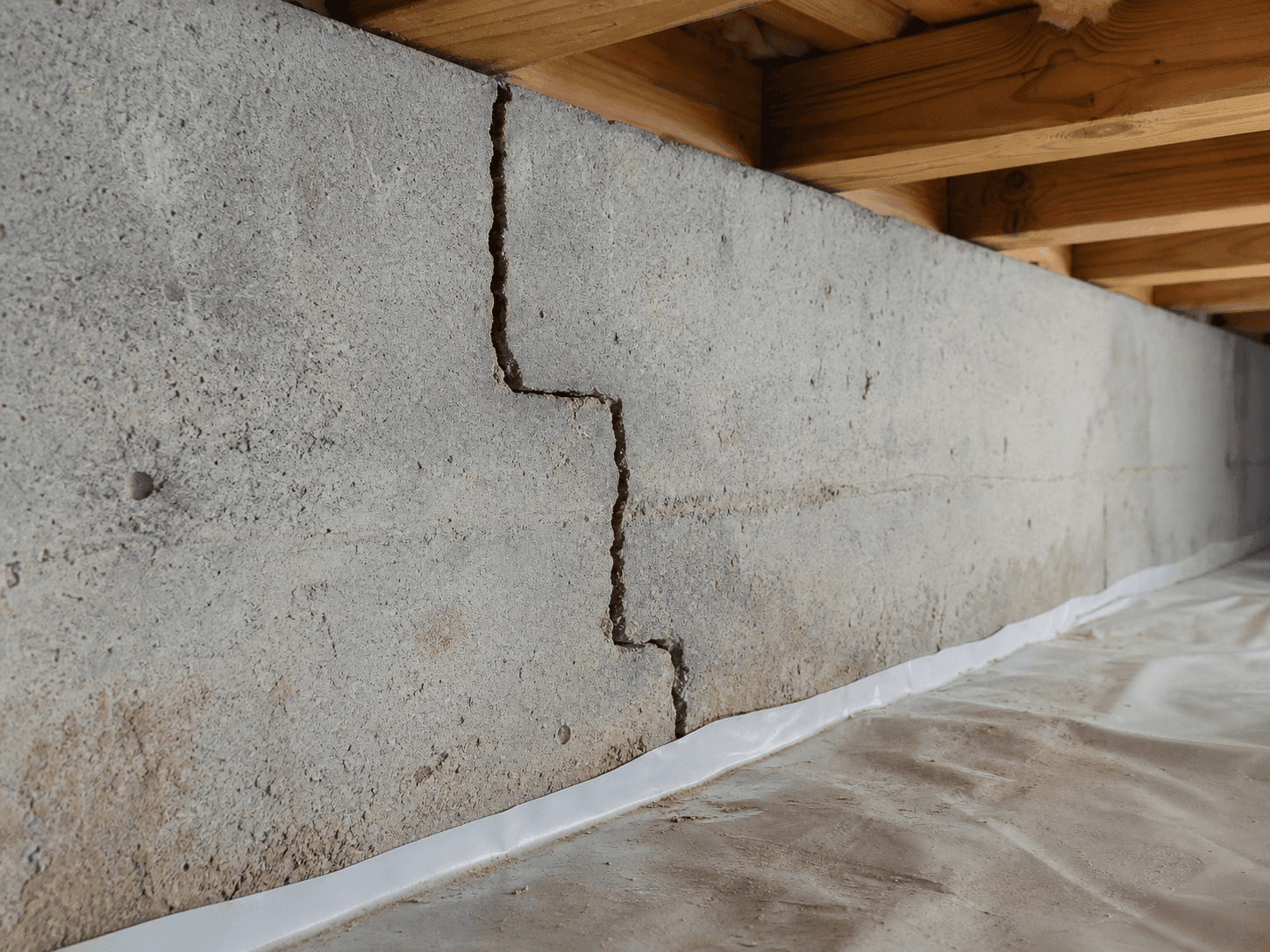
This page is about the horizontal concrete surface you walk on: a slab-on-grade floor, or the concrete floor of a basement. That is a different structure from a foundation wall, it fails in different ways, and the advice does not transfer cleanly between them. If your crack is in a vertical wall, you want vertical cracks in a foundation wall or horizontal cracks instead, and the foundation cracks overview covers all types together.
The reason the distinction matters: a wall crack is usually read by direction, because direction tells you which way the wall is being pushed. A slab has no such orientation — it lies flat and is supported from underneath along its whole area. What a slab crack tells you comes from its pattern and from whether the two sides are still in the same plane.
The main thing
Four ways a slab cracks, and what each means
Nearly every page you will find on this subject sorts cracks by width alone. Width is useful, and it is further down this page, but it is the second question. The first is which of these four things you are looking at, because two of them are ordinary and two of them mean something is happening beneath the slab.
| Pattern | What it looks like | What it usually means |
|---|---|---|
| Shrinkage / craze cracking | Thin, often meandering or web-like. Appears in the first year or two, usually no displacement, both sides flush. | Generally cosmetic. Note it and move on unless it widens later. |
| Control joint cracking | A straight crack running exactly along a saw-cut or tooled groove in the slab. | Working as designed — the joint exists to put the crack there. Concerning only if the two sides move out of level. |
| Settlement cracking | One side of the crack sits lower than the other. Often wider at one end, and may run diagonally across a corner or a room. | Support beneath the slab has been lost or compacted. Worth a professional evaluation, especially if it is still moving. |
| Heave cracking | One side sits higher than the other, sometimes with the slab domed or tented near the middle of a room. | Something below is pushing up — expansive soil, trapped moisture, or in some cases a plumbing leak. Worth evaluating. |
The quickest test for the two that matter: lay a straightedge or a level across the crack and see whether it rocks, or simply run your foot over it barefoot. A crack you can feel a step in — a lip, in either direction — has displacement, and displacement is what separates a slab that is cracked from a slab that has moved.
Don’t panic
The crack that is supposed to be there
If your crack runs dead straight along a groove in the slab, you are almost certainly looking at a control joint doing its job. Because concrete is going to shrink and crack as it cures, slabs are cut or tooled with grooves at intervals to create a deliberate weak line, so the crack forms where somebody chose rather than wherever it liked. A cracked control joint is the expected outcome, not a defect.
Two things would change that reading. If the two sides of a control joint are no longer level with each other, the joint has stopped being a shrinkage feature and started being a movement one. And if a crack runs straight for a while and then wanders off away from the joint line, the part that wandered is worth a closer look. Control joints in a garage or basement floor are usually visible; under carpet or tile they are not, which is one reason a crack in a finished room is harder to interpret.
Measuring it
How wide is too wide
Once you know the pattern, width and change give you the urgency. These are general guides rather than limits, and they hold for a crack with no displacement — a narrow crack with a lip outranks a wider one without.
| Crack width | What it typically looks like | What to do |
|---|---|---|
| Under about 1/8 inch | Hairline. Both sides flush, dry, no change over time. | Commonly cosmetic. Mark it, date it, and check it again in a few months. |
| About 1/8 to 3/16 inch | Noticeable. Still flush and dry, but wide enough to be worth tracking properly. | Measure and monitor. Re-check after heavy rain and after a dry spell. |
| Wider than about 3/16 inch | Wide, or narrower but with a lip you can feel, water coming through, or visible growth. | Worth a professional evaluation rather than continued watching alone. |
| Any width, but changing | Measurably wider or longer than it was at the last reading. | Change matters more than size. A growing crack is the clearest signal on this page. |
The same width thresholds and the movement rate behind them are published on the crack monitoring log, which will track a slab crack the same way it tracks a wall crack — mark the ends, record the width and the date, and let the readings answer the “is it getting worse” question instead of memory.
The hard part
When you can’t see the foundation
A home on a crawl space lets you go and look at the foundation. A slab home does not: the foundation is the floor, and the floor is under tile, carpet, vinyl, or laminate. Most homeowners on a slab never see a crack directly. They see what the crack does to whatever is on top of it, which means reasoning from indirect evidence.
Flooring that keeps failing in a line
Tiles cracking along the same line across a room, or grout that fails repeatedly in the same seam, often follows a crack in the slab beneath. A single cracked tile is usually just a cracked tile.
A ridge or dip underfoot
Vinyl and laminate telegraph displacement. A raised line you can feel through the flooring suggests the two sides of something below are no longer level.
Gaps at the baseboard
A gap opening between the floor and the baseboard on one side of a room can mean the slab has dropped there — or that the wall has moved. It is a prompt to measure, not a conclusion.
Doors that started catching
Slab movement racks door frames the same way wall movement does. What matters is that it started, and roughly when.
Because none of those signs is conclusive on its own, the useful move on a slab home is to measure the floor rather than hunt for the crack. The floor slope calculator turns a drop and a span into a comparable number, and a slope that shows up in the same part of the house as the failing flooring is a far stronger signal than either on its own. See also sloping or uneven floors, doors and windows that stick, and signs a house is settling.
One slab-specific cause worth ruling out: a leaking supply or drain line beneath the slab can saturate or wash out the soil supporting it, and it can do so for a long time without being obvious. Unexplained damp patches, a warm spot on the floor, or a water bill that has crept up without explanation are all worth mentioning to whoever inspects — a plumbing problem is a different repair from a foundation one.
Local context
Slab homes in eastern North Carolina
Most of the older housing stock around Rocky Mount, Wilson, and Tarboro sits on a crawl space rather than a slab, so slab-on-grade here tends to mean newer construction, an addition, a garage, or a basement floor. That has a practical consequence: much of the slab-crack advice online is written for markets like Texas and Colorado where slabs dominate and where highly expansive clay drives seasonal movement, and it does not transfer directly to the coastal plain.
The soils across eastern North Carolina vary considerably, and the region’s more common issues tend to involve water — saturated soil after prolonged rain, and drainage that directs water toward the house rather than away from it. Our North Carolina foundation risk report covers the regional geology, and foundation problems after heavy rain covers the storm-driven pattern specifically. None of this substitutes for someone assessing your own lot and soil.
Repair
How slab cracks get repaired
Stable, narrow cracks are typically filled — epoxy or polyurethane injection, or a semi-rigid filler where the floor carries traffic or equipment. Where a slab has lost support beneath it, the conversation moves to restoring that support instead: options commonly discussed include injecting a grout or foam under the slab to fill voids and lift it, or piering, depending on what has happened below and how far it has gone.
The caveat that applies to every one of them is the same. Filling a crack closes the crack; it does not change what opened it. If soil is still settling or still heaving, the repair will be tested again — which is why a crack that is actively moving is usually assessed before it is filled, not after. See foundation crack repair for how repairs are approached and crack repair cost for planning ranges. Nothing here should be taken as a recommendation for your slab without an in-person look.
FAQ
Slab foundation crack FAQs
Are cracks in a slab foundation normal?
Most of them are. Concrete shrinks as it cures and cracks are the ordinary result, which is why builders place control joints to decide in advance where that cracking will happen. Thin, stable, dry cracks in a slab are common and usually cosmetic. What separates those from cracks worth investigating is not their presence but their width, whether one side sits higher than the other, whether they pass water, and whether they are still changing.
How wide does a slab crack have to be before it matters?
As a general guide, hairline cracks under about an eighth of an inch are usually treated as cosmetic, cracks between an eighth and three-sixteenths of an inch are worth measuring and watching, and cracks wider than about three-sixteenths of an inch are commonly the point at which a professional look is recommended. Width is only one factor though. A narrow crack with a lip you can feel underfoot is more significant than a wider one that is perfectly flush.
What causes a slab foundation to crack?
Four things, and they leave different marks. Shrinkage as the concrete cures produces thin, often meandering or map-like cracking early in a slab's life. Control joints crack because they were cut to. Settlement, where soil beneath the slab compacts or washes away, leaves a crack with one side dropping relative to the other. Heave, where soil below expands or water pushes up, does the opposite and lifts one side. Poor drainage and plumbing leaks under the slab contribute to the last two.
Do all slab foundations crack?
Very nearly. Concrete has high compressive strength and low tensile strength, so as it cures and shrinks it relieves the stress by cracking somewhere. The industry answer is that concrete cracks are a question of where, not whether, which is precisely why control joints exist. A slab with no visible cracks at all usually has flooring over the ones it has.
Is a crack in a slab foundation bad?
Usually not, on its own. It becomes worth attention when it is wider than roughly three-sixteenths of an inch, when the two sides are no longer level with each other, when it passes water or shows white mineral deposits, when it is measurably growing, or when it appears alongside other symptoms — sloping floors, doors that have started catching, cracks opening at door and window corners. Any single one of those is a reason to have it looked at; several together more so.
How do you seal cracks in a slab foundation?
Stable, narrow cracks are commonly filled with an epoxy or polyurethane injection, or a semi-rigid filler where the slab carries traffic. The important caveat is that sealing closes the crack without addressing why it opened. If the crack is the result of settlement or heave still underway, the filler will simply crack again — which is why a crack that is actively moving is assessed before it is filled rather than after.
How can I tell if my slab is cracked under the flooring?
Often you cannot see it directly, and that is the awkward part of living on a slab. The indirect signs are the ones to work from: tile that cracks in a line or grout that keeps failing along the same seam, vinyl or laminate that develops a ridge or a dip, a spot that sounds hollow underfoot, gaps opening between the floor and the baseboard, or doors that have started to catch. None of those confirms a slab crack by itself, but a line of cracked tiles running across a room is worth taking seriously.
Related guidance
Related pages
Local help
Foundation guidance in eastern North Carolina
If a crack in your slab has you unsure whether to fill it or watch it, start by writing down what you can see. Use the foundation problem assessment to organize the symptoms, or request an inspection to be pointed toward an appropriate professional.